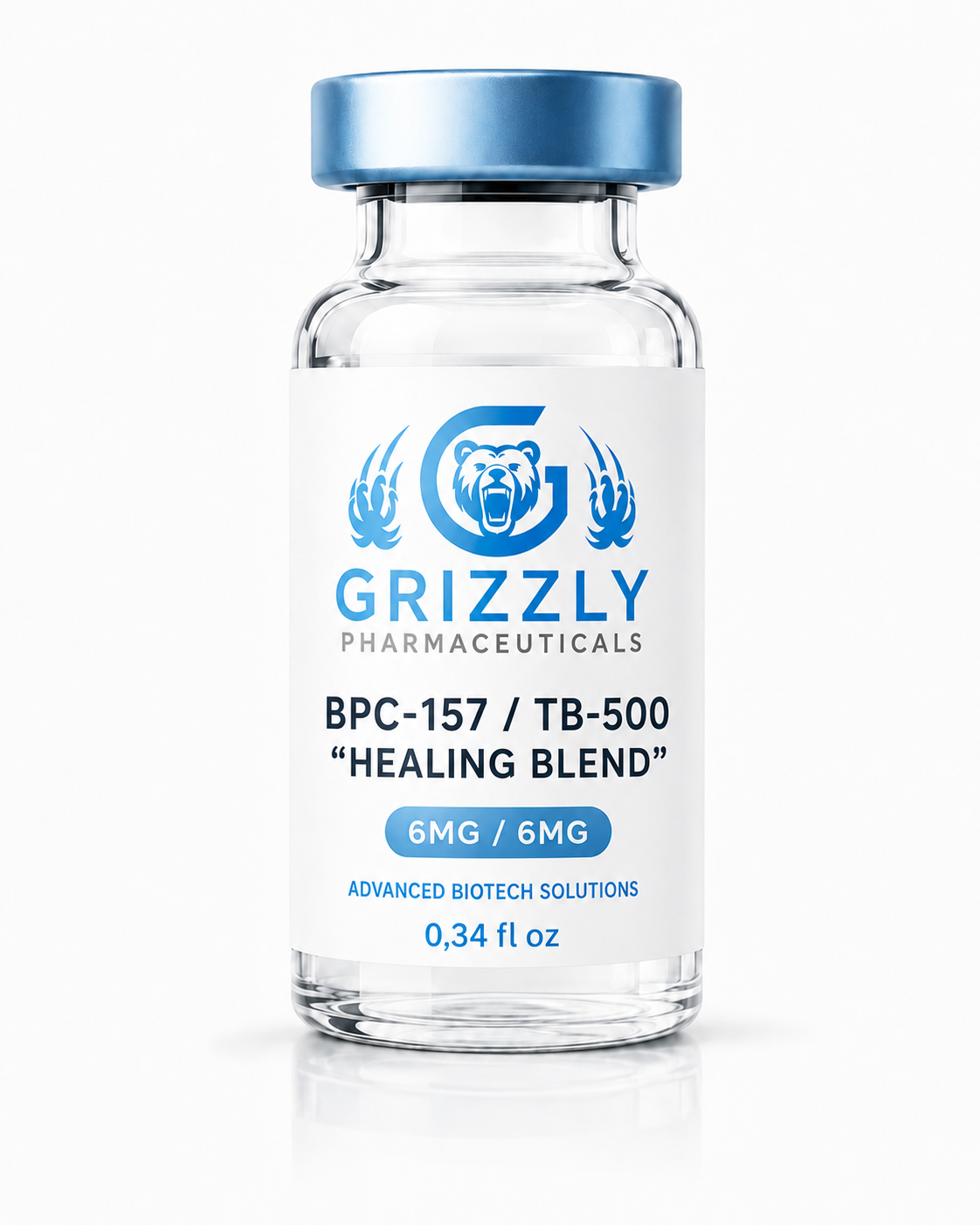
Ultimate Regenerative Healing Blend — 6MG / 6MG
Disclaimer: This product is for laboratory research purposes only. Not for human consumption.
Standardized handling, dosing, and storage guidelines for the BPC-157 / TB-500 Wolverine Stack.
The Wolverine Stack combines BPC-157 (Body Protection Compound) and TB-500 (Thymosin Beta-4 Fragment) into a single, synergistic dual-peptide blend — each dosed at 6MG for a combined 12MG of regenerative power. BPC-157 accelerates localized tissue repair and gut healing via angiogenesis and growth factor upregulation, while TB-500 promotes systemic cellular migration and inflammation control. Together, they represent the most comprehensive recovery peptide stack in research today — beloved by the research community for near-legendary healing properties, hence the name: the Wolverine Stack.
BPC-157 begins driving angiogenesis at the injury site. TB-500 starts recruiting repair cells systemically. Inflammation begins to reduce rapidly.
| Compound | Coverage | Key Strength | Administration |
|---|---|---|---|
| Wolverine Stack (BPC+TB) | Local + Systemic | Full-spectrum regeneration | SubQ |
| BPC-157 Alone | Local / Targeted | Angiogenesis & gut repair | SubQ / Oral |
| TB-500 Alone | Systemic | Cellular migration & flexibility | SubQ |
A dual-action regenerative system: BPC-157 drives localized angiogenesis and tissue repair while TB-500 promotes systemic cellular migration and actin polymerization — creating full-spectrum recovery coverage.
Upregulates VEGF (Vascular Endothelial Growth Factor), accelerating the formation of new blood vessels to damaged tissue for faster nutrient and growth factor delivery to the repair site.
TB-500 binds to actin G, promoting cell migration and proliferation — the fundamental cellular drivers of wound closure and tissue rebuilding on a systemic scale.
BPC-157 handles targeted local repair while TB-500 recruits repair cells system-wide — creating a full-spectrum healing environment that neither peptide can achieve alone.
Both peptides independently modulate pro-inflammatory cytokines, collectively reducing chronic inflammation and significantly speeding recovery timelines across musculoskeletal and gastrointestinal tissues.
4-6 hours (short-acting, dosing frequency dependent).
7-10 days (long-acting, sustains systemic coverage).
High for both compounds via subcutaneous injection.
BPC-157: Enzymatic degradation. TB-500: Renal / lymphatic.
Both peptides have extensive pre-clinical evidence supporting their role in tissue regeneration, wound healing, and musculoskeletal repair — individually and synergistically.
Explore the mechanisms behind BPC-157's rapid healing properties and its impact on angiogenesis.
Research OverviewA deep dive into how Thymosin Beta-4 fragments regulate actin and promote systemic recovery.
Explore research-use products associated with this compound profile, including available formats, related blends, and supporting lab documentation where available.
Explore supporting tools, protocol references, and batch documentation to help navigate research-use product information.
Review reference-oriented handling, preparation, and storage notes for laboratory research workflows.
View protocolsUse our research calculator for reference preparation workflows and lab-focused planning support.
Open calculatorAccess available batch documentation, lab testing references, and certificates of analysis where available.
View COAsDeeper research-focused questions about the BPC-157 / TB-500 Wolverine Stack, peptide component roles, tissue-repair research models, cell migration, extracellular matrix pathways, storage, and batch documentation.
The BPC-157 / TB-500 Wolverine Stack is a dual-peptide research blend commonly discussed in tissue-support, cell-migration, extracellular matrix, angiogenesis-related, and repair-associated laboratory models. BPC-157 and TB-500 are not the same compound, but they are frequently grouped together because both are discussed in research categories involving tissue response, wound-model endpoints, and repair pathway signaling. On this site, the Wolverine Stack is positioned strictly as a laboratory research reference product.
“Wolverine Stack” is an informal nickname commonly used in peptide communities to describe the pairing of BPC-157 and TB-500 because both compounds are often discussed in repair-associated research models. The name should be treated as a marketing nickname, not as a clinical claim. The research-focused way to describe the blend is as a dual-peptide formulation centered on tissue-support models, cellular migration, angiogenesis-related endpoints, and extracellular matrix research.
The Wolverine Stack typically refers to a blend containing BPC-157 and TB-500. BPC-157 is commonly discussed as a stable gastric pentadecapeptide in tissue-support and gastrointestinal research models, while TB-500 is commonly discussed in relation to thymosin beta-4 research categories, actin dynamics, cell migration, and tissue-remodeling models. Because this is a blend, the page should explain both the combined product and the individual role of each component.
BPC-157 is commonly referenced in research involving gastrointestinal models, tendon and ligament models, wound-model endpoints, angiogenesis-related pathways, collagen-associated research, and nitric oxide pathway discussions. Within the Wolverine Stack, BPC-157 helps anchor the blend around tissue-support and repair-associated research categories while still keeping the content limited to laboratory and analytical reference use.
TB-500 is commonly discussed in relation to thymosin beta-4 research, actin regulation, cell migration, tissue remodeling, and repair-associated biological pathways. In the context of the Wolverine Stack, TB-500 helps support the blend’s research profile around cytoskeletal dynamics, cell movement, extracellular matrix interaction, and wound-model research endpoints.
BPC-157 and TB-500 are different peptide categories with different research profiles. BPC-157 is usually discussed as a stable gastric pentadecapeptide connected to gastrointestinal, tendon, ligament, vascular, and wound-model research. TB-500 is typically discussed through thymosin beta-4-related research categories involving actin binding, cell migration, cytoskeletal dynamics, and tissue-remodeling models. Their pairing is popular because the research themes are complementary, not because the two compounds are identical.
TB-500 is commonly discussed in connection with thymosin beta-4, but it should not automatically be treated as identical to every full thymosin beta-4 product or clinical research material. In educational peptide content, TB-500 is usually positioned around thymosin beta-4-related pathways, particularly actin, cell migration, and tissue remodeling research. Keeping the distinction clear helps avoid overstating what a research-use blend is intended to represent.
The Wolverine Stack is discussed in tissue-repair research because both BPC-157 and TB-500 are commonly referenced in laboratory models involving wound response, tissue remodeling, angiogenesis-related endpoints, collagen and extracellular matrix pathways, cell migration, and inflammatory signaling. The combined page gives visitors a clear way to understand the research rationale behind the pairing without turning the content into human-use instructions or therapeutic claims.
BPC-157 / TB-500 is commonly associated with research areas involving tissue remodeling, tendon and ligament models, wound-model endpoints, extracellular matrix research, angiogenesis-related signaling, cell migration, cytoskeletal dynamics, gastrointestinal tissue models, and inflammatory pathway research. Because it contains two separate peptides, it is best described as a blend-based research product rather than a single-compound profile.
Wolverine Stack research discussions may involve endpoints connected to collagen organization, extracellular matrix remodeling, fibroblast activity, angiogenesis-related markers, cell migration, cytoskeletal signaling, inflammatory pathway markers, wound-model closure, tendon and ligament models, and gastrointestinal tissue-support research. The exact endpoints depend on the study model, analytical methods, and whether the research is focused on BPC-157, TB-500, or the combined blend.
The Wolverine Stack overlaps with GLOW and KLOW because these blends may share repair-associated peptides such as BPC-157 and TB-500. However, the Wolverine Stack is more narrowly focused on the BPC-157 and TB-500 pairing. GLOW is usually positioned around skin, copper peptide, and tissue-support research, while KLOW may include KPV and broader inflammatory pathway research. For SEO and internal linking, each blend should have its own page because the research angles and component explanations are different.
Storage requirements can vary by product format, batch, and label instructions. For research handling, follow the product label and applicable laboratory storage standards. In general, research peptides should be protected from unnecessary heat, light, moisture, and repeated temperature changes because these conditions may affect long-term stability and handling quality.
Available certificates of analysis and batch documentation can be reviewed through the Lab Results / COA page. Documentation availability may vary by product and inventory lot. Where available, batch documentation may include product identification, purity-focused testing references, and supporting analytical documentation.
Yes. BPC-157 / TB-500 products listed on Symbiotic Pharmaceuticals are intended for laboratory research and analytical reference use only. They are not intended for human consumption, animal consumption, diagnostic use, therapeutic use, injury treatment, athletic recovery use, cosmetic use, or self-administration. Any discussion on this page is provided for educational and research-reference purposes only.
The information provided in this resource hub is for educational and informational purposes only. These products are not intended to diagnose, treat, cure, or prevent any disease.